
April 5, 2026 · 5 min read
Emotional Intelligence: The Skill That Shapeshifts
The same person praised as 'unflappable' at work may be described as 'emotionally unavailable' at home. EQ isn't one skill — it's two, wearing the same name.
Daniel Goleman’s research across 188 companies found that emotional intelligence was twice as important as IQ and technical skills combined for performance at every level — and at the C-suite, 85-90% of the competencies distinguishing top performers were EI-based. TalentSmart’s dataset of over 500,000 people showed that 90% of top performers scored high on EQ, and high-EQ individuals earned an average of $29,000 more per year. The numbers are striking, but they hide something important: the emotional intelligence that makes someone a brilliant leader is not the same emotional intelligence that makes someone a good partner. The competencies overlap in name — self-awareness, empathy, regulation — but diverge sharply in what they actually demand.
Two kinds of empathy, two kinds of composure
The workplace rewards cognitive empathy — the ability to understand what someone else is thinking and feeling, often in order to influence an outcome. You read the room in a negotiation, calibrate your message for a difficult stakeholder, deliver feedback in a way that lands without causing defensiveness. This is perspective-taking deployed strategically, and it works. But intimate relationships run on affective empathy — actually feeling what the other person feels, sitting with their pain without trying to fix it, being moved rather than merely informed. John Gottman’s four decades of research on couples found that the single strongest predictor of relationship survival was the rate at which partners “turned toward” each other’s small emotional bids — 86% for couples who stayed together, 33% for those who divorced. That turning-toward is not a strategic calculation. It’s an involuntary resonance.
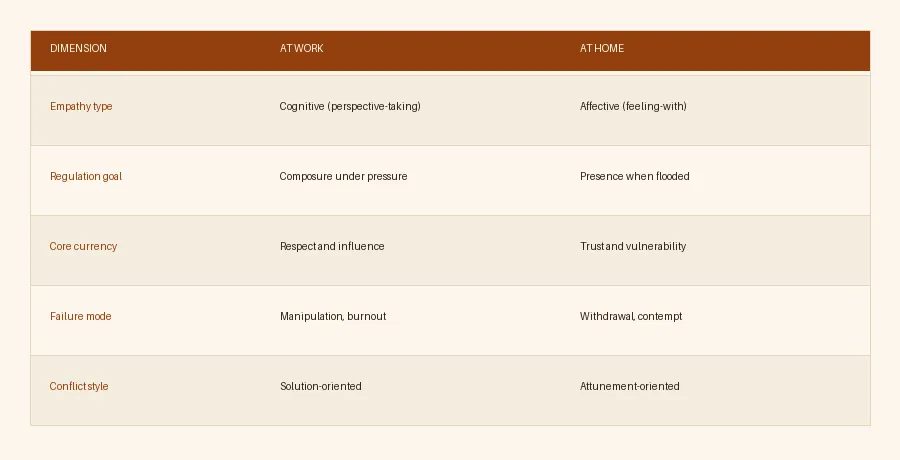
The same regulation strategy — emotional suppression — is adaptive in one context and corrosive in the other.
This is where the composure trap lives. The executive praised as unflappable — calm in a crisis, measured in their responses, never visibly rattled — may be using suppression as their primary regulation strategy. Stanford psychologist James Gross distinguishes between reappraisal (reframing a situation, which is healthy) and suppression (hiding your emotional expression, which carries costs). Suppression is associated with reduced relationship satisfaction, lower social support, and worse memory for emotional interactions. At work, it looks like leadership. At home, it reads as emotional unavailability. The person who can brilliantly manage a boardroom conflict may freeze when their partner needs them to simply say “that sounds really hard.” Solution-orientation — the managerial instinct to identify problems and implement fixes — becomes invalidating when someone needs to be heard, not managed. Professional feedback frameworks feel clinical and patronizing in a kitchen at 11pm.
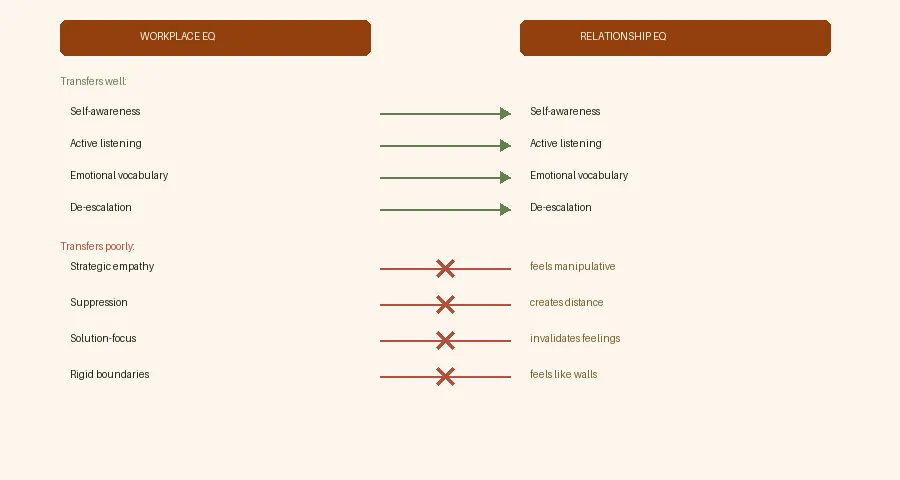
The skills that don’t transfer share a common thread: they treat emotions as problems to be managed rather than experiences to be shared.
There’s a darker dimension. Kilduff et al.’s research on the strategic use of emotional intelligence showed that high EQ combined with Machiavellian traits produces skilled manipulators — people who can read emotions acutely without being moved by them. Cognitive empathy without affective empathy is the profile of the charming narcissist. In the workplace, this dissociation is tolerated, even rewarded: the executive who reads a counterpart’s anxiety and leverages it is called strategically savvy. The partner who does the same during an argument is called emotionally abusive. The line between influence and manipulation is often just the context. And there’s a resource problem: Hochschild’s concept of emotional labor — the managed emotional display demanded by certain jobs — depletes the very reserves needed for authentic connection. People in high-EQ-demand roles (therapists, teachers, leaders, healthcare workers) often have the least emotional bandwidth left for their relationships. The best workplace empaths may be the worst at empathy at home — not from lack of skill, but from depletion.
Attachment style is the hidden moderator. Avoidantly attached individuals often look like high-EQ leaders — calm, task-focused, composed under pressure — while being deeply limited in relational EQ. Anxiously attached individuals may be exquisitely attuned to others’ emotions but so dysregulated by their own that the skill becomes counterproductive. Secure attachment correlates with higher scores on both cognitive and affective empathy. It’s the only style where workplace EQ and relational EQ genuinely converge.
Sue Johnson’s Emotionally Focused Therapy — built on attachment theory — has a 70-75% recovery rate for distressed couples and 90% showing significant improvement. The relational EQ it teaches is specific: recognizing that your partner’s anger often masks fear of disconnection, tolerating vulnerability long enough for repair to happen, expressing needs without criticism. These are learnable skills, but they require a fundamentally different orientation than workplace EQ demands. The workplace asks: how can I use this emotional information? Relationships ask: can I let this emotional information change me? The gap between those two questions is where most emotionally intelligent professionals stumble at home. Closing it doesn’t require abandoning the skills that made you effective at work. It requires recognizing that effectiveness in love is measured in presence, not outcomes.