
April 5, 2026 · 5 min read
Doing a PhD: The Plan Is Not the Journey
A PhD proposal is the most important document you'll write — and almost none of it will survive contact with reality. What actually happens between enrollment and defense.
Everyone enters a PhD with a plan. The plan looks linear: coursework, literature review, research, writing, defense. Five clean boxes on a timeline, one after another. The reality is that over 60% of PhD students significantly change their research direction at least once, the average completion time in the US is 5.8 years across all fields (7-9 in the humanities), and roughly 40-50% of students in the humanities never finish at all. The NSF, the Council of Graduate Schools, and every honest advisor will tell you the same thing: the plan is a demonstration that you can think systematically about a problem. It is not a prediction of what will actually happen. The gap between the proposal and the defense is where the real PhD lives — and it looks nothing like the brochure.
The valley no one warns you about
There’s a well-documented emotional arc to the PhD that maps with eerie consistency across disciplines, countries, and decades. Year one is uninformed optimism: everything feels possible, the reading is exciting, you haven’t yet discovered how hard your specific problem is. By year two, informed pessimism sets in — early results disappoint, the literature reveals how much ground has already been covered, and the distance between where you are and a finished thesis becomes viscerally real. Year three is the valley. Levecque et al.’s 2017 study in Research Policy found that one in three PhD students is at risk of developing a common psychiatric disorder — 2.4 times higher than the general highly-educated population. A 2020 meta-analysis by Satinsky et al. pooled data from 23,000+ graduate students and found depression prevalence at 24%, six times the general population rate. The Nature 2019 survey of 6,000 PhD students reported that 56% felt isolated and only 26% were satisfied with their work-life balance. These are not anecdotes. They are structural features of a system that asks people to work on ill-defined problems for years, largely alone, with uncertain outcomes and minimal external structure.
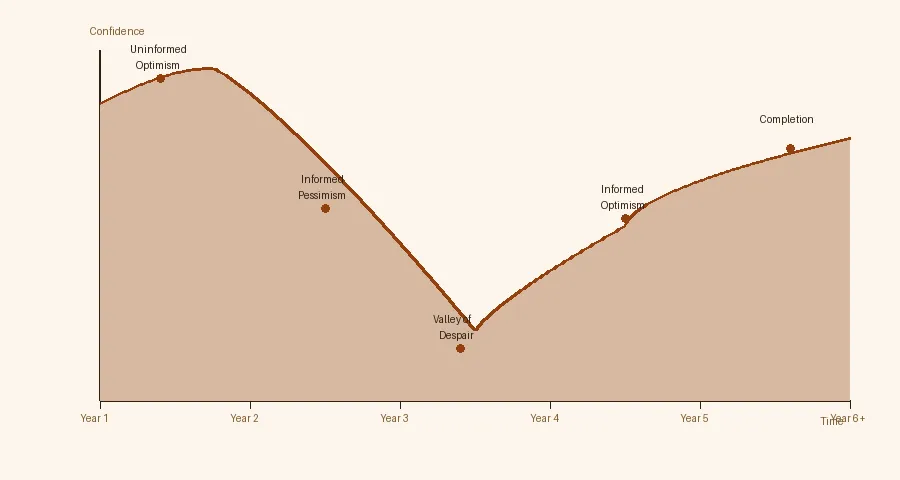
The curve ends higher than the valley but lower than the initial peak. You don’t return to naive confidence — you arrive at earned competence. That’s the actual transformation.
The practical dimension is less discussed but equally brutal. In STEM, 70-90% of individual experiments produce null, unexpected, or uninterpretable results. In the humanities, the equivalent is discovering your thesis already exists, your archive is empty, or your theoretical framework collapses under scrutiny. The advisor relationship — not the intellectual challenge — is the single strongest predictor of whether you finish. A Nature Biotechnology study found that students whose advisors met with them weekly were significantly more likely to complete on time. But the relationship is not teacher-student; it’s closer to master-apprentice, with all the power asymmetry that implies. Students who thrive tend to do two things early: they talk to the advisor’s current and former students before committing, and they establish explicit expectations about feedback cadence and communication style.
The writing phase starts earlier and ends later than anyone expects. The research phase is not a block — it’s recursive, fragmented, and overlapping with everything else.
So why do it? Because the thesis is not the point. Only 3.5% of PhD graduates in the UK end up in permanent academic positions. The thesis sits in a database. What persists is the transformation: the ability to frame a question rigorously, to tolerate years of ambiguity without abandoning the work, to manage a project with no external project manager, to synthesize vast bodies of information into a coherent argument, and to communicate complex ideas clearly under pressure. These are the skills below the waterline — invisible on a CV but present in every conversation, every decision, every problem you face afterward.
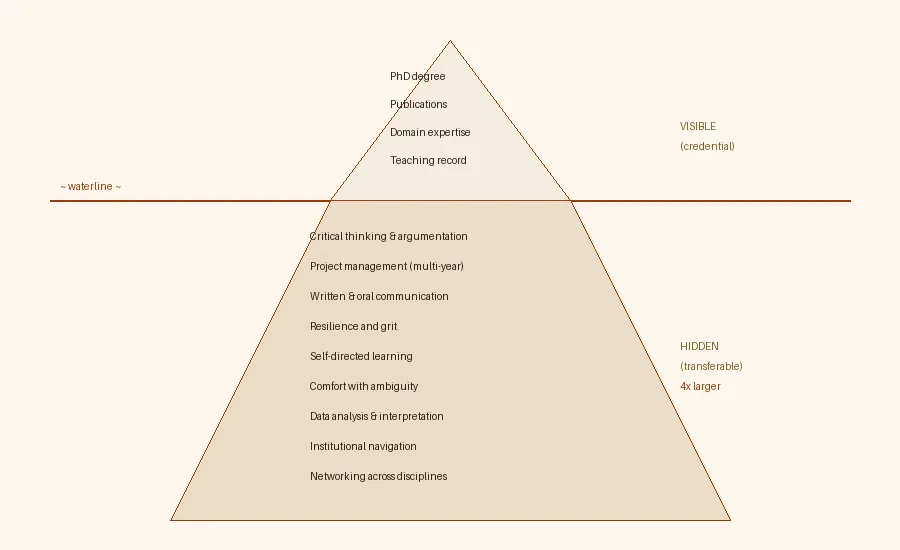
The below-waterline skills are what employers actually hire for — and what former PhD students consistently identify as the most valuable thing they gained.
The honest advice from the other side is always the same, and it’s always simpler than people expect. Write every day, even when you think you have nothing to say — writing is thinking, not recording thought. Set small, concrete weekly goals rather than staring at the enormity of a multi-year project. Maintain at least one identity outside academia — a sport, a craft, a community — because the students who do this report higher satisfaction and comparable completion rates. Keep a research journal so that when the valley convinces you that you’ve accomplished nothing, you have concrete evidence otherwise. And know when to pivot: if three different approaches to the same question have failed, reconsider the question. If one approach has failed, try a different approach. The PhD is not an intellectual challenge. It is an emotional endurance test. The people who finish are not necessarily the smartest. They’re the ones who learned to keep working when the plan — that clean, linear, confident plan — dissolved into something messier, harder, and more honest.